When optimizing query performance tuning in PostgreSQL, choosing the right index type is critical. A PostgreSQL hash index is a specialized index structure designed primarily to accelerate exact match queries. While the default B-tree index is versatile enough for most workloads, understanding when a hash index provides a tangible advantage—and when it falls short—is essential for backend developers and DBAs aiming to maximize data retrieval speed.
TL;DR: A PostgreSQL hash index is optimized exclusively for equality operations (
=). It uses a hash table data structure to map keys to disk locations, offering smaller index sizes than B-trees. However, due to query planner optimization tendencies and historical limitations, B-trees are often preferred unless index size overhead is a primary concern.
What is a PostgreSQL Hash Index?
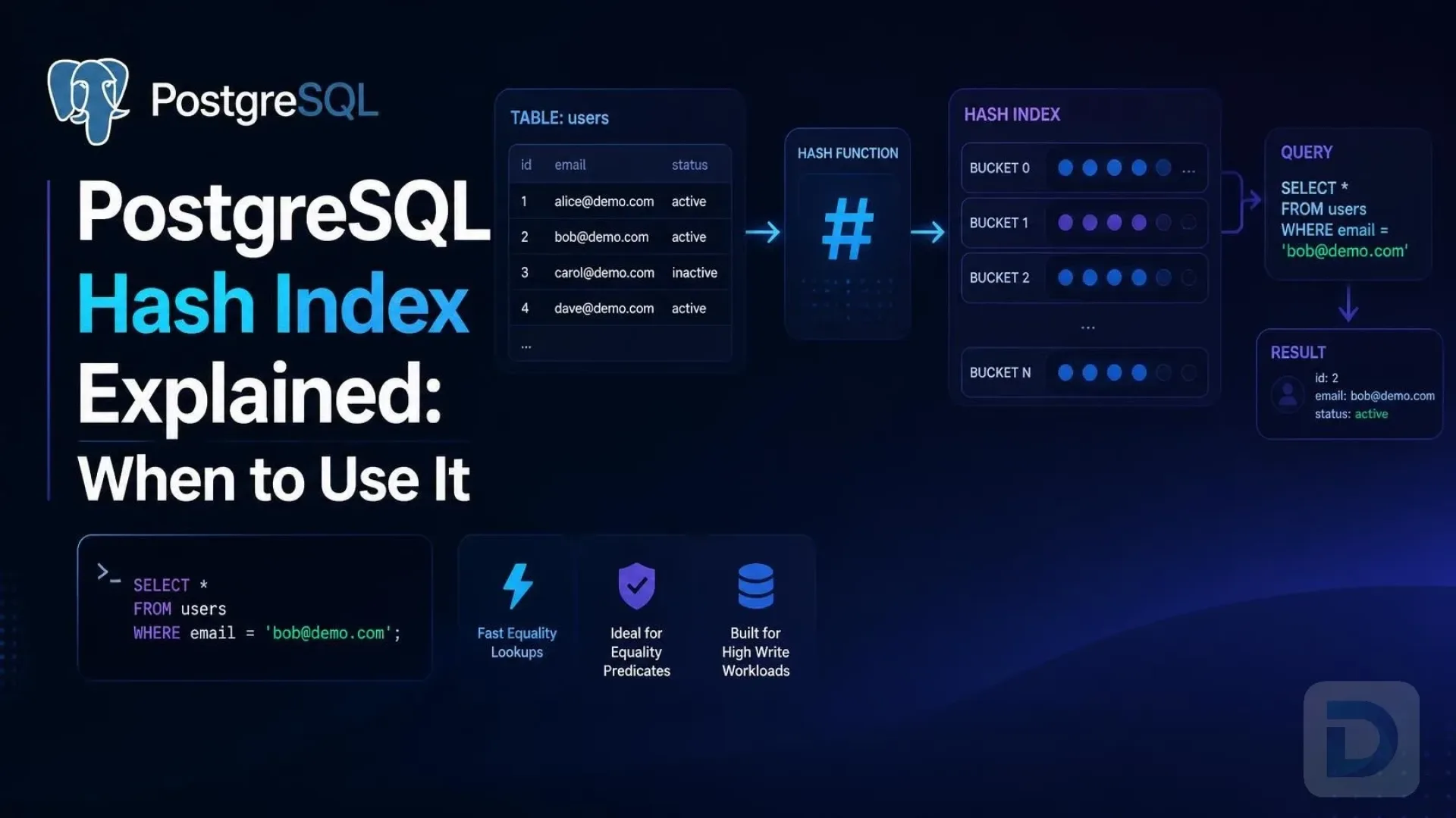
To answer the common question: does PostgreSQL support hash indexes? Yes, it does. However, they are rarely the default choice. A hash index implements a standard hash table on disk. When you insert a row, PostgreSQL passes the indexed column value through a hash function. The resulting hash code maps to a specific bucket, which stores a pointer to the actual table row (CTID).
Unlike a B-tree, which maintains sorted data to handle ranges and sorting, a hash index cares only about exact matches. This single-minded focus makes index type selection crucial: if your queries only use the = operator, a hash index is theoretically the most efficient tool for the job.
How PostgreSQL Hash Indexes Work Under the Hood
Understanding the internals helps clarify why these indexes behave the way they do. The architecture is straightforward but relies on careful management of hash buckets.
The Hash Function and Buckets
PostgreSQL uses a 32-bit hash function to map indexed data to one of many hash buckets. Each bucket acts as a container for pointers to table rows. Because the hash code is fixed in size (32 bits), the index size overhead remains consistently small regardless of the size of the actual indexed data. For example, indexing a massive text field with a hash index takes up significantly less disk space than a B-tree index, which must store the full text payload.
When a query executes an equality check, the database hashes the search term, calculates the target bucket, and scans only the pointers within that specific bucket. This results in an O(1) lookup time complexity, which is highly efficient.
Handling Collisions
Because a 32-bit hash code has a limited number of unique values, different inputs will inevitably produce the same hash code—a hash function collision. When this happens, multiple row pointers end up in the same hash bucket. PostgreSQL handles this by linking these pointers together within the bucket. If a bucket becomes too full, PostgreSQL splits it into multiple buckets to maintain fast lookup times, though this splitting process adds slight maintenance overhead during heavy write operations.
When to Use a Hash Index in PostgreSQL
Deciding when to use a hash index in PostgreSQL requires analyzing your query patterns strictly. The only scenario where a hash index is appropriate is when a column is queried exclusively using equality operations (=).
A classic postgres hash index example is a session token lookup or a UUID primary key where you only ever retrieve records by the exact ID:
SELECT * FROM user_sessions WHERE session_token = 'abc123xyz';
If you never query session_token using <, >, ORDER BY, or LIKE, a hash index is a viable candidate. It is particularly useful when dealing with large indexed values (like long strings or UUIDs) where the reduced index size overhead translates directly to more cache hits and less disk I/O.
Hash Index vs B-Tree Index in PostgreSQL
The debate of postgres hash index vs b-tree almost always ends in favor of the B-tree, but understanding why is important. Here is a breakdown of how they compare.
| Feature | Hash Index | B-Tree Index |
|---|---|---|
| Data Structure | Hash Table | Balanced Tree |
| Supported Operators | = only | =, <, >, <=, >=, BETWEEN, LIKE, IS NULL |
| Index Size | Smaller (stores only 32-bit hash) | Larger (stores full key) |
| Lookup Complexity | O(1) | O(log N) |
| Sorting Support | None | Native |
| Default Index Type | No | Yes |
While O(1) complexity sounds superior to O(log N), in practice, B-tree indexes are so highly optimized that the difference in data retrieval speed for a single equality lookup is often negligible. Furthermore, B-trees provide flexibility that hash indexes lack.
Limitations of PostgreSQL Hash Indexes
Despite their theoretical efficiency for exact match queries, PostgreSQL hash index limitations have historically kept them out of the mainstream. While modern versions of PostgreSQL have addressed the most critical issues, several limitations remain.
Lack of WAL Support Prior to Version 10
If you read older database literature, you will see severe warnings against hash indexes. Before the PostgreSQL 10 release notes, hash indexes did not support write-ahead logging (WAL). This meant that after a database crash, any hash index had to be rebuilt using REINDEX. Since PostgreSQL 10, WAL is fully supported, making them crash-safe. However, the stigma from older versions persists in the DBA community.
No Range Query Support
This is a hard architectural limit. If you execute a query like WHERE id > 1000 or WHERE created_at BETWEEN '2023-01-01' AND '2023-12-31', a hash index will be completely ignored. It cannot be used for ordering or pattern matching (LIKE). If you accidentally create a hash index on a column that later requires range filtering, you will experience sudden performance degradation.
Query Planner Hesitancy
Even when a hash index is perfectly suited for an equality query, query planner optimization often still chooses a B-tree index if one exists. The PostgreSQL planner's cost estimation algorithms are heavily tuned for B-trees. In many benchmark scenarios, the planner assumes a B-tree scan will be cheaper, causing it to ignore the hash index unless forced via index hints or if no B-tree is available.
How to Create and Manage Hash Indexes
If you have determined that your workload fits the strict criteria, creating and managing these indexes is straightforward.
Basic Creation Syntax
To create a hash index, you must explicitly define the USING HASH clause. If you omit this, PostgreSQL defaults to a B-tree.
CREATE INDEX idx_session_hash ON user_sessions USING HASH (session_token);
You can also build them concurrently to avoid locking the table for writes:
CREATE INDEX CONCURRENTLY idx_session_hash ON user_sessions USING HASH (session_token);
To verify if the query planner is actually using your new index, use the EXPLAIN ANALYZE command. If you notice the planner ignoring your hash index in favor of a B-tree, you may need to drop the B-tree on that specific column to force the planner's hand.
Using Hash Indexes with DBO Studio
Managing multiple index types across large schemas can be tedious via the command line. With DBO Studio, you can visually inspect your tables, identify missing indexes for your frequent equality queries, and create hash indexes through an intuitive GUI. DBO Studio makes it easy to compare index sizes and immediately see how different index types impact your query execution plans without leaving the application. Check the latest DBO Studio releases for updated PostgreSQL index management features.
FAQ
The primary use case is accelerating exact match queries (using the = operator) on columns with large data sizes, such as long strings or UUIDs, where minimizing index storage overhead is critical.
Yes, in modern PostgreSQL (version 10 and later). Older versions lacked WAL support, making them unsafe after crashes, but this limitation has been fully resolved. They now fully support concurrent index builds and standard write-ahead logging.
The PostgreSQL query planner's cost estimation is heavily optimized for B-trees. Even for equality operations, the planner often calculates that a B-tree will be faster or equally fast, causing it to ignore the hash index unless it is the only available index on that column.
No. A hash index strictly supports the = operator. It cannot be used for <, >, <=, >=, BETWEEN, or LIKE queries. For those operations, you must use a B-tree, GIN, or GiST index.
Theoretically, hash indexes offer O(1) lookup time compared to a B-tree's O(log N). However, in real-world PostgreSQL environments, the performance difference for simple equality checks is often negligible because B-trees are deeply optimized and frequently cached in memory.
Key Takeaways
- A PostgreSQL hash index is strictly designed for equality operations (
=) and ignores range or sorting queries. - They offer smaller index sizes by storing 32-bit hash codes instead of full column values.
- Prior to PostgreSQL 10, they were not crash-safe due to missing WAL support, but this is no longer the case.
- The query planner often favors B-trees even for equality checks, making hash indexes less commonly used in practice.
- They are best reserved for exact-match lookups on wide columns where index size directly impacts memory efficiency.
Conclusion
While the PostgreSQL hash index is a fascinating piece of database architecture, its practical applications are narrow. For the vast majority of use cases, the default B-tree index provides better overall flexibility and comparable speeds for equality lookups. However, if you are dealing with massive tables, exact match queries, and need to aggressively minimize index size overhead, the hash index remains a valuable tool in your PostgreSQL optimization arsenal. As always, test with EXPLAIN ANALYZE and monitor your specific workload to make data-driven indexing decisions.
About the author

Founder & Lead Developer at DBO Studio
Full-stack developer and creator of DBO Studio, a modern database management tool. Passionate about PostgreSQL, MySQL, SQLite, database performance, developer productivity, and building tools that simplify database workflows.
Try this in DBO Studio
Explore PostgreSQL workflows visually in DBO Studio — schemas, queries, and plans in one place.
Our newsletter
Subscribe to DBO Studio’s newsletter for exclusive tutorials, tips & product updatesRelated posts