TL;DR
PostgreSQL BRIN (Block Range INdex) indexes are tiny, low-maintenance indexes designed for very large tables where data is naturally ordered on disk. They store only min/max summaries per block range instead of per-row pointers, making them orders of magnitude smaller than B-tree indexes. If you manage time-series or append-only workloads, understanding the postgresql brin index can save you significant storage and maintenance overhead.
Introduction
Indexes are the backbone of query performance in PostgreSQL, but not all indexes are created equal. For tables with billions of rows, a traditional B-tree index can become a storage burden, consuming gigabytes of disk space and slowing down writes. PostgreSQL 9.5 introduced a fundamentally different approach: the BRIN index.
A postgresql brin index trades granularity for efficiency. Instead of tracking the location of every row, it summarizes ranges of blocks, recording only the minimum and maximum values found within each range. This design makes BRIN uniquely suited to large table optimization scenarios where storage efficiency matters more than pinpoint accuracy.
What Is a BRIN Index and How Does It Work?

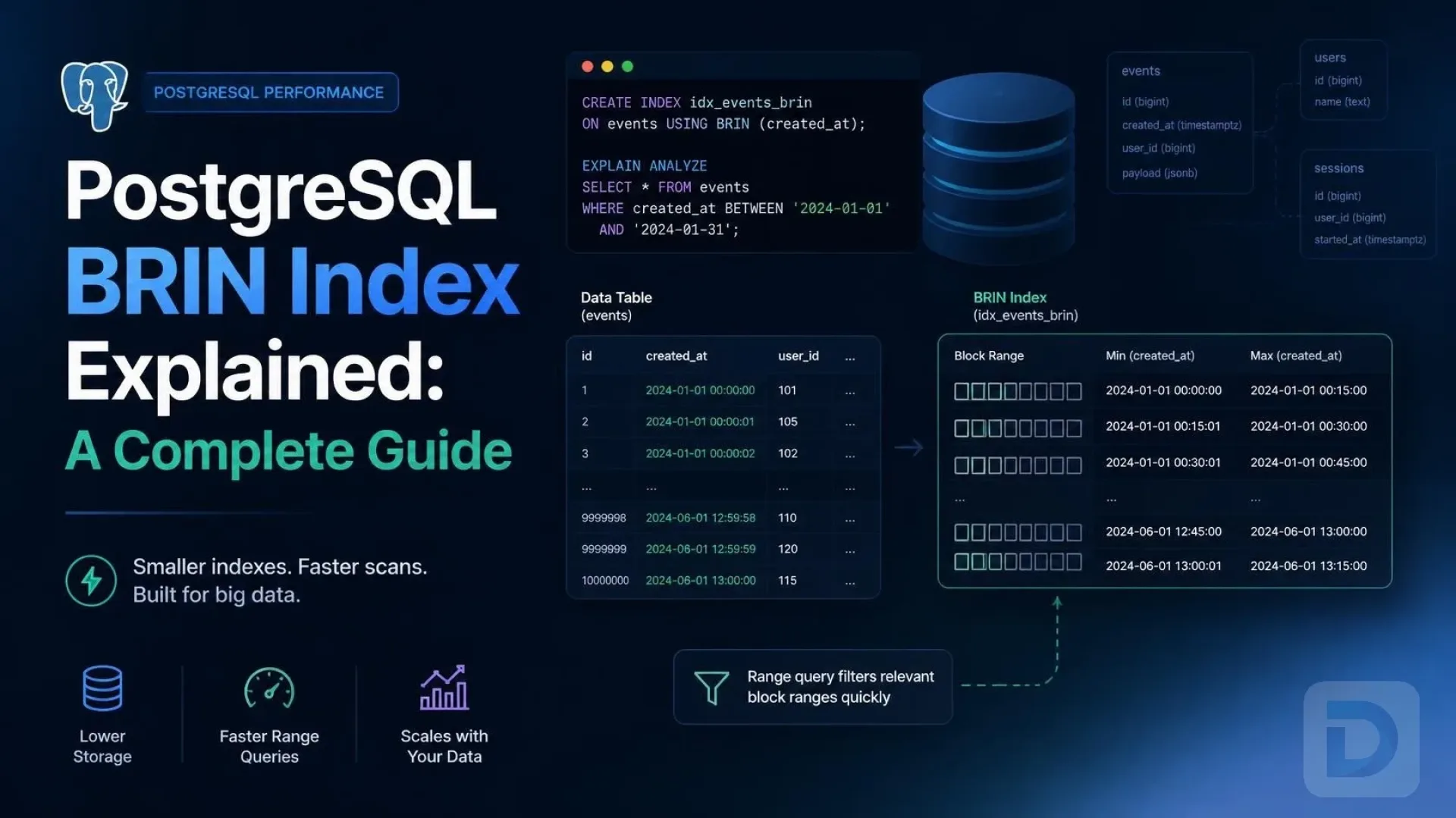
B-tree stores a pointer for every row; BRIN stores only min/max summaries per block range, yielding massive space savings on correlated data.
Block Range Structure and Summarization
BRIN stands for Block Range INdex. At its core, a BRIN index divides the table's heap into contiguous ranges of pages—by default, 128 pages per range. For each range, PostgreSQL stores a single summarization tuple containing metadata about the values inside that range.
The most common operator class, minmax, stores exactly two values per column per range: the smallest value and the largest value. When a query asks for rows within a specific range, PostgreSQL checks the BRIN summary. If the target range falls outside the min/max bounds of a block range, that entire range is excluded from the scan. If it overlaps, PostgreSQL reads the blocks and applies the query predicate directly to the heap tuples.
How BRIN Stores Min/Max Values per Range
Unlike a B-tree, which maintains a sorted tree of individual row pointers, a postgresql block range index is essentially a flat array of summaries. The index entry for a range is updated only when new data is inserted into that range or when VACUUM processes it. This append-friendly behavior is why BRIN shines on append-only workloads.
The summarization is stored in a separate relation (the BRIN index itself), and because each range covers many pages, the total index size remains tiny even for terabyte-scale tables.
The Role of Correlation in BRIN Effectiveness
BRIN effectiveness depends heavily on correlation—how closely the logical order of your data matches its physical storage order on disk. When you insert time-series data with a monotonically increasing timestamp, the correlation coefficient approaches 1.0. In this case, each block range contains a tight cluster of values, and the min/max summary is highly selective.
If your data is randomly distributed (for example, UUID primary keys), the min and max values in each block range will span nearly the entire value domain. The query planner will find the summaries unhelpful, and a BRIN index will offer little to no benefit. This is the most important factor in the brin index vs btree decision.
When to Use a BRIN Index (vs. B-Tree)

Use this decision tree to determine whether your workload and data patterns favor BRIN over B-tree.
Ideal Workloads: Time-Series and Append-Only Data
The canonical use case for a postgresql brin index is time-series data. Event logs, sensor readings, audit trails, and metrics tables typically receive inserts with ever-increasing timestamps. Because new rows are appended to the end of the table, physical storage order remains highly correlated with the timestamp column.
Range scans on these tables—queries like "find all events between Monday and Friday"—are exactly the access pattern BRIN is designed to accelerate. The index allows the query planner to skip entire block ranges that fall outside the date range, reducing I/O dramatically.
Correlation Requirements and Data Ordering
Before creating a BRIN index, check your data's correlation using pg_stats:
SELECT attname, correlation
FROM pg_stats
WHERE tablename = 'events' AND attname = 'created_at';
A correlation value above 0.9 indicates that BRIN will likely be effective. Values below 0.5 suggest the data is too scattered on disk for BRIN to provide meaningful range exclusion.
You can improve correlation by clustering the table on the target column, though this requires a maintenance window and an exclusive lock:
CLUSTER events USING idx_events_created_at;
When B-Tree Is Still the Better Choice
B-tree indexes remain the right tool for many jobs. Use B-tree when:
- You need exact-match lookups (
WHERE id = 42). - Your data has low correlation (random inserts, UUIDs).
- You require uniqueness constraints.
- Query latency for individual rows is critical.
BRIN is not a replacement for B-tree; it is a complement for specific read-heavy workloads on massive tables.
How to Create and Configure a BRIN Index
Basic CREATE INDEX Syntax
Creating a BRIN index is straightforward:
CREATE INDEX idx_events_created_at_brin
ON events USING BRIN (created_at);
This creates a default BRIN index with pages_per_range set to 128. The index will immediately begin summarizing existing data and will update summaries as new rows are inserted.
Choosing pages_per_range
The pages_per_range parameter controls how many heap pages each summary covers. The default is 128, but you can tune it:
CREATE INDEX idx_events_created_at_brin
ON events USING BRIN (created_at)
WITH (pages_per_range = 32);
A smaller value increases index granularity, potentially improving selectivity at the cost of a larger index. A larger value shrinks the index further but may reduce effectiveness if correlation is imperfect. There is no universal ideal; the right value depends on your table size, correlation, and query patterns. Start with the default and adjust based on execution plan analysis.
Available Operator Classes
PostgreSQL ships with several BRIN operator classes:
| Operator Class | Description | Best For |
|---|---|---|
minmax | Stores min and max values per range | Ordered numeric, timestamp, and integer data |
inclusion | Supports range types and geometric types | tstzrange, int4range, spatial data |
bloom | Uses Bloom filters for multi-column support | Columns with moderate cardinality where exact min/max is less useful |
For most users, minmax is the correct starting point. The inclusion opclass is valuable when indexing native PostgreSQL range types.
Performance Considerations and Maintenance
Query Planner Behavior with BRIN
When a query uses a BRIN index, PostgreSQL performs a bitmap index scan. The index returns a bitmap of pages that might contain matching rows, and the executor reads those pages sequentially. This is less precise than a B-tree index scan but far more I/O-efficient on large range queries.
You can verify BRIN usage with EXPLAIN (ANALYZE, BUFFERS):
EXPLAIN (ANALYZE, BUFFERS)
SELECT * FROM events
WHERE created_at BETWEEN '2024-01-01' AND '2024-01-31';
Look for Bitmap Index Scan on idx_events_created_at_brin in the output.
Impact of VACUUM and Table Bloat
BRIN indexes rely on accurate summaries. When rows are updated or deleted, the dead tuples remain in the heap until VACUUM reclaims them. If a block range contains many dead tuples, the min/max summary may become less precise, though BRIN is generally more resilient to table bloat than B-tree indexes.
Running VACUUM ANALYZE periodically ensures statistics stay current and summaries remain accurate. For append-only tables, a simple ANALYZE after bulk loads is often sufficient.
Monitoring BRIN Index Efficiency
To assess whether your BRIN index is pulling its weight, compare the index size to the table size:
SELECT
  relname AS index_name,
  pg_size_pretty(pg_relation_size(indexrelid)) AS index_size
FROM pg_stat_user_indexes
WHERE relname LIKE '%brin%';
A well-functioning postgresql brin index should be a tiny fraction of the table size—often kilobytes versus gigabytes. If query performance is poor, verify that the planner is using the index and that your data correlation remains high.
FAQ
BRIN stands for Block Range INdex. It summarizes contiguous ranges of heap pages rather than indexing individual rows.
A B-tree index stores a separate entry for every row, enabling fast exact-match and ordered retrieval. A BRIN index stores only one summary (typically min/max) per block range, making it vastly smaller but less precise. This is the core of the brin index vs btree trade-off.
Use BRIN when you have a very large table with highly correlated data—especially time-series or append-only workloads—and your queries primarily use range scans. Use B-tree for exact lookups, low-correlation data, and uniqueness constraints.
The default of 128 works well for most cases. Reduce it for better selectivity on smaller tables or imperfectly correlated data; increase it for massive tables with near-perfect correlation. Always test with EXPLAIN ANALYZE.
No. UUIDs and other randomly distributed values have extremely low correlation. The min/max summaries would span nearly the entire value space, making the index ineffective. Use B-tree for these columns.
On a billion-row table, a B-tree index might consume tens of gigabytes, while a BRIN index on the same column typically uses only a few megabytes. The savings scale with table size.
Yes. BRIN indexes work on individual partitions and are often an excellent choice for partitioned time-series tables where each partition covers a specific time range.
BRIN indexes have minimal write overhead. Because they do not maintain per-row pointers, inserting a new row typically requires updating at most one summary tuple. This is one of the key brin index performance advantages over B-tree on write-heavy workloads.
Key Takeaways
- A postgresql brin index is a block-level summary index, not a row-level index.
- It excels on large, correlated datasets—especially time-series and append-only tables.
- Storage savings are dramatic: BRIN indexes are often thousands of times smaller than equivalent B-tree indexes.
- Correlation is everything. Check
pg_statsbefore deploying BRIN. - BRIN does not replace B-tree; it complements it for specific large-table scenarios.
- Maintenance is minimal, but keep an eye on table bloat and run
ANALYZEafter bulk operations.
Conclusion
For engineers and DBAs managing PostgreSQL at scale, the postgresql brin index is a powerful tool in the indexing toolkit. It will not solve every performance problem, but on the right workload—large, ordered, range-scanned tables—it delivers outsized value with negligible storage cost.
If you are evaluating database tools that make index management and query analysis easier, consider giving DBO Studio a try. Our cross-platform GUI helps you inspect execution plans, monitor index usage, and manage PostgreSQL, MySQL, SQLite, and SQL Server databases from a single interface. Check out our latest releases to see what's new.
For the authoritative reference on BRIN internals, consult the PostgreSQL BRIN documentation and the CREATE INDEX syntax page.
About the author

Founder & Lead Developer at DBO Studio
Full-stack developer and creator of DBO Studio, a modern database management tool. Passionate about PostgreSQL, MySQL, SQLite, database performance, developer productivity, and building tools that simplify database workflows.
Try this in DBO Studio
Explore PostgreSQL workflows visually in DBO Studio — schemas, queries, and plans in one place.
Our newsletter
Subscribe to DBO Studio’s newsletter for exclusive tutorials, tips & product updatesRelated posts