TL;DR
** A PostgreSQL GIN index (Generalized Inverted Index) is an inverted index architecture designed to handle composite values—like arrays, JSONB, and full-text search vectors. It maps individual elements to row IDs, delivering rapid lookups on complex data types where traditional B-trees fail.
A postgresql gin index is essential for modern database query optimization when dealing with non-scalar data. Whether you are querying nested JSONB documents, performing full-text search, or filtering arrays, understanding how the GIN index works is critical for maintaining high postgres gin index performance.
Introduction
What is a GIN Index?
In PostgreSQL, a GIN index is a generalized inverted index. Unlike a standard B-tree index, which is designed for scalar values (like integers or strings) and range queries, a GIN index is built to handle composite values. It breaks down a value into its constituent elements (or keys) and stores a mapping from each key back to the original row (via a Tuple ID, or TID).
This makes it the default and most efficient index type for operations like checking if an array contains a specific element, or if a JSONB document contains a specific key-value pair.
Why GIN is Essential for Modern PostgreSQL Workloads
Modern applications rarely store purely tabular data. Developers increasingly rely on flexible schemas using JSONB, complex text search using tsvector, and multi-value array columns. As these workloads grow, sequential scans become a performance bottleneck.
A postgres jsonb gin index or postgres array gin index allows the database engine to locate rows containing specific nested data without scanning the entire table. For backend developers and DBAs, leveraging GIN indexes is a fundamental step in database query optimization.
How the PostgreSQL GIN Index Works

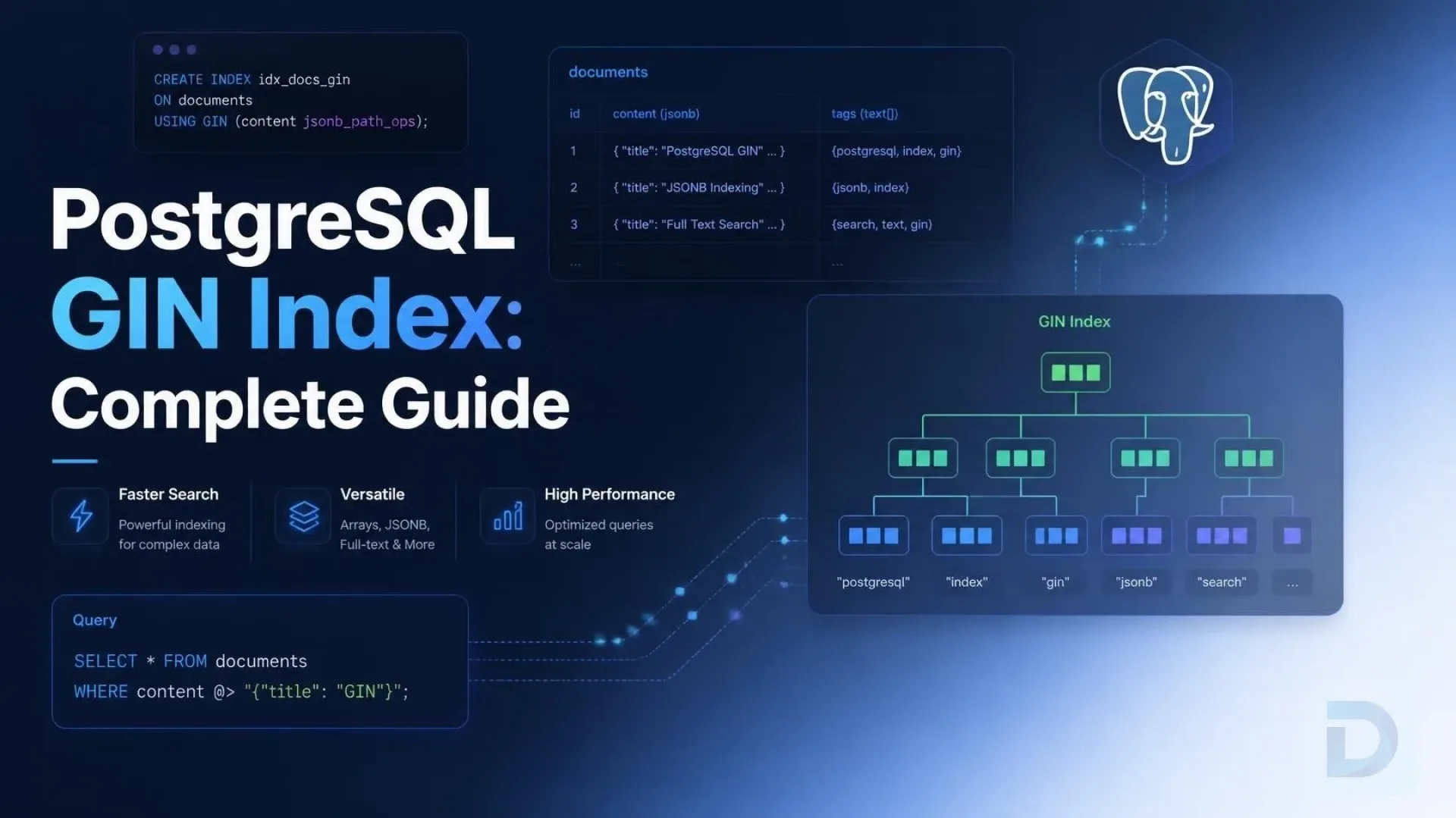
Architecture of an inverted index mapping composite values to row IDs.
Understanding the Inverted Index Architecture
The core of a GIN index is its inverted index database structure. When you insert a composite value (e.g., an array [1, 2, 3]), PostgreSQL does not store the array as a single entity in the index. Instead, it breaks it down:
- Key Extraction: The index extracts individual elements (1, 2, and 3).
- Posting Lists: For each key, the index maintains a list of Tuple IDs (TIDs) pointing to the table rows containing that key.
When you query WHERE my_array @> ARRAY[2], PostgreSQL looks up the key 2 in the GIN index, retrieves the posting list of TIDs, and fetches those specific rows. This architecture is highly efficient for read-heavy workloads on multi-valued columns.
Operator Classes Supported by GIN
A GIN index relies on operator classes to know how to extract keys from a specific data type. The most common gin index operator classes include:
jsonb_ops(default for JSONB): Supports operators like@>,?,?|, and?&.array_ops(default for arrays): Supports operators like@>(contains),<@(contained by), and&&(overlaps).tsvector_ops(default for tsvector): Supports full-text search matching (@@).
By default, PostgreSQL selects the appropriate operator class based on the column type, but you can explicitly define it if needed.
Primary Use Cases for GIN Indexes
Indexing JSONB Data
The most common modern use case for a GIN index is optimizing JSONB queries. Without an index, finding a document containing a specific attribute requires a full table scan.
-- Create a table with JSONB data
CREATE TABLE users (
    id serial PRIMARY KEY,
    profile jsonb NOT NULL
);

-- Create a GIN index on the JSONB column
CREATE INDEX idx_users_profile ON users USING gin (profile);

-- Query optimized by the GIN index
SELECT * FROM users WHERE profile @> '{"role": "admin"}';
This postgres jsonb gin index allows PostgreSQL to instantly find all users where the profile JSONB contains the "role": "admin" key-value pair.
Accelerating Full-Text Search
A postgresql full text search index heavily relies on GIN. When you convert text into a tsvector, GIN breaks the document into individual lexemes (words) and maps them to row IDs.
-- Create a GIN index for full-text search
CREATE INDEX idx_articles_body ON articles USING gin (to_tsvector('english', body));

-- Query using the tsvector index
SELECT title FROM articles
WHERE to_tsvector('english', body) @@ to_tsquery('english', 'postgresql & performance');
For deeper text matching (like fuzzy search or trigrams), developers often use the pg_trgm extension, which also provides a GIN operator class (gin_trgm_ops) to accelerate LIKE and ILIKE queries.
Querying Arrays
Arrays are natively supported by the GIN architecture. A postgres array gin index is invaluable when filtering rows based on array containment.
CREATE TABLE projects (
    id serial PRIMARY KEY,
    tags text[]
);

CREATE INDEX idx_projects_tags ON projects USING gin (tags);

-- Find projects that contain both 'postgres' and 'database' tags
SELECT * FROM projects WHERE tags @> ARRAY['postgres', 'database'];
Creating and Managing GIN Indexes
Syntax for Creating a GIN Index
If you are wondering how to create gin index postgres tables, the syntax is straightforward. You simply specify USING gin in the CREATE INDEX statement.
CREATE INDEX index_name ON table_name USING gin (column_name);
For specific operator classes, the syntax extends slightly:
CREATE INDEX idx_trgm_name ON users USING gin (name gin_trgm_ops);
Using Expression Indexes with GIN
Often, you don't want to index a column directly, but rather the result of a function applied to that column. GIN fully supports expression indexes. This is highly useful for indexing JSONB paths or converting text to tsvector on the fly.
-- Indexing a specific JSONB path
CREATE INDEX idx_user_zip ON users USING gin ((profile->'address'->'zipcode'));
Maintaining and Rebuilding GIN Indexes
Like all PostgreSQL indexes, GIN indexes can suffer from bloat over time due to updates and deletes. Because updating a composite value means updating multiple keys in the posting lists, maintenance is crucial. You can rebuild a GIN index without locking the table using REINDEX CONCURRENTLY:
REINDEX INDEX CONCURRENTLY idx_users_profile;
PostgreSQL GIN vs GiST: Choosing the Right Index

Performance comparison between GIN and GiST indexes in PostgreSQL.
When dealing with full-text search, JSONB, or geometric data, developers face the decision of gin vs gist postgres indexes. Both are valid, but they optimize for different things.
Performance Comparison: Read vs Write Speeds
- GIN (Generalized Inverted Index): Optimized for read performance. Lookups are extremely fast because the index directly maps keys to TIDs. However, writes are slower because PostgreSQL must update multiple posting lists for a single row insertion.
- GiST (Generalized Search Tree): A balanced, extensible search tree. Writes are generally faster than GIN. However, lookups are slower because GiST requires traversing the tree and often produces "lossy" results that require re-checking against the actual table data.
When to Use GIN Over GiST
Choose GIN when:
- Your workload is read-heavy.
- You need exact matches on JSONB or array containment.
- You are performing full-text search and need the fastest query speeds.
Choose GiST when:
- Your workload is write-heavy.
- You are dealing with geometric data (like PostGIS) or overlapping ranges.
Optimizing GIN Index Performance
Configuring the GIN Pending List
Because writing to a GIN index can be slow, PostgreSQL implements a mechanism called the gin pending list. Instead of updating the main inverted index immediately, new keys are inserted into a pending list. Once the pending list reaches a certain size, it is bulk-inserted into the main index.
Tuning fast_update for Write-Heavy Workloads
The fast_update parameter controls this behavior. By default, it is enabled.
- Enabled (fast_update = on): Improves write performance by deferring index updates. Queries might be slightly slower because they must scan both the main index and the pending list.
- Disabled (fast_update = off): Degrades write performance but maximizes query read speed, as there is no pending list to check.
You can configure this via the gin_pending_list_limit server parameter or per-index:
-- Disable fast_update for maximum read speed
ALTER INDEX idx_users_profile SET (fast_update = off);
For write-heavy workloads, keeping fast_update enabled but tuning the gin_pending_list_limit (e.g., to 4MB or 8MB) is often the best compromise. If you want to learn more about index tuning, check out our guide on PostgreSQL index optimization or explore advanced features in our documentation.
Monitoring GIN Index Bloat
Over time, especially with heavy deletes and updates, the posting lists in a GIN index can become bloated with dead entries. Regularly use the pgstattuple extension to monitor index density and reclaim space with REINDEX or VACUUM when necessary.
FAQ
A GIN (Generalized Inverted Index) is an index architecture in PostgreSQL designed for composite data types like arrays, JSONB, and full-text search vectors. It breaks down multi-valued data into individual keys, mapping each key back to the row IDs that contain it.
You should use a GIN index instead of a B-tree when querying composite values where you need to check if an element exists within an array, a key exists in a JSONB document, or a word exists in a text document. B-trees are suited for scalar values and exact matches or ranges, while GIN handles multi-valued containment operations.
Yes. GIN is the primary and fastest index type for PostgreSQL full-text search. It indexes the tsvector representation of text, allowing rapid lookup of documents containing specific lexemes.
To optimize a GIN index for write-heavy workloads, ensure that the fast_update parameter is enabled. This defers index updates by batching new entries into a pending list. You can also tune the gin_pending_list_limit to balance write speed and query latency.
Yes, creating a postgres jsonb gin index is the standard way to optimize queries on JSONB columns. It supports containment operators like @>, allowing PostgreSQL to quickly find documents containing specific key-value pairs without scanning the entire table.
Conclusion
The PostgreSQL GIN index is a powerful tool for any backend developer or DBA working with modern, non-scalar data types. By understanding its inverted index architecture, knowing when to apply it to JSONB, arrays, and full-text search, and properly tuning parameters like fast_update, you can drastically improve database query optimization.
While writes can be more expensive than traditional B-trees, the read performance gains on complex data are unmatched. To manage your PostgreSQL databases more effectively, download DBO Studio or view our latest releases. For more technical details, refer to the official PostgreSQL GIN documentation.
About the author

Founder & Lead Developer at DBO Studio
Full-stack developer and creator of DBO Studio, a modern database management tool. Passionate about PostgreSQL, MySQL, SQLite, database performance, developer productivity, and building tools that simplify database workflows.
Try this in DBO Studio
Explore PostgreSQL workflows visually in DBO Studio — schemas, queries, and plans in one place.
Our newsletter
Subscribe to DBO Studio’s newsletter for exclusive tutorials, tips & product updatesRelated posts