TL;DR
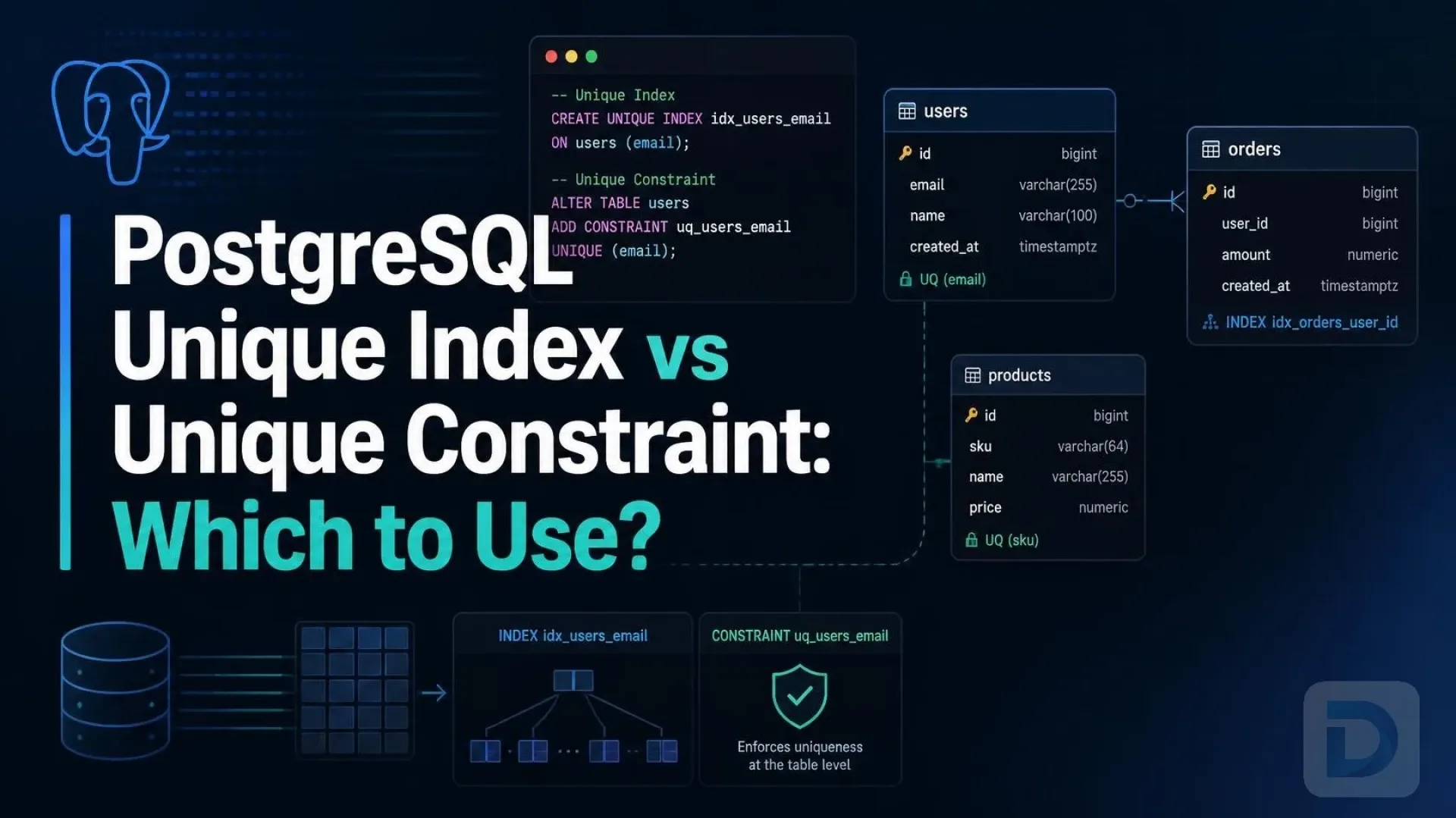
In PostgreSQL, every unique constraint is enforced by a unique B-tree index, but not every unique index backs a constraint. Use a UNIQUE constraint as your default for data integrity, and reach for a standalone CREATE UNIQUE INDEX when you need partial predicates, expressions, or a concurrent build.
The PostgreSQL unique index vs unique constraint question comes up in almost every schema review. The two look interchangeable: both prevent duplicate values, both show up as indexes in \d output, and both work as ON CONFLICT targets for upserts. The real difference is not storage — it is the feature set wrapped around the index, plus how catalogs, ORMs, and migration tools see your schema. This guide covers how each one works, where they genuinely differ, and which to choose in production migrations.
What Is a PostgreSQL Unique Constraint?
A unique constraint is a table-level rule that forbids two rows from holding the same value — or the same combination of values — in the constrained columns. Unlike a primary key, a table can carry many unique constraints, and their columns allow NULL by default. You declare one inline in CREATE TABLE or add it later with ALTER TABLE ... ADD CONSTRAINT.
Inline and named constraint syntax
CREATE TABLE users (
  id        bigint GENERATED ALWAYS AS IDENTITY PRIMARY KEY,
  tenant_id bigint NOT NULL,
  email     text   NOT NULL,
  CONSTRAINT users_tenant_email_key UNIQUE (tenant_id, email)
);

ALTER TABLE users
  ADD CONSTRAINT users_email_key UNIQUE (email);
A multicolumn unique constraint guarantees that the combination is unique, not each column individually — a common point of confusion.
How PostgreSQL implements it under the hood
Adding a unique constraint always creates a unique B-tree index to enforce it; there is no index-free option. Verify this in pg_indexes or with \d users — the index is typically named after the constraint. The constraint depends on that index, so PostgreSQL treats the two as one linked unit. This implementation detail drives most of the differences below.
Multi-column constraints and NULLS NOT DISTINCT
By default, PostgreSQL treats NULL values as distinct, so multiple rows with NULL in a unique column never conflict. Since PostgreSQL 15, NULLS NOT DISTINCT reverses that behavior for both constraints and unique indexes:
ALTER TABLE users
  ADD CONSTRAINT users_email_key UNIQUE NULLS NOT DISTINCT (email);
What Is a Unique Index in PostgreSQL?
A unique index is an index object created directly with CREATE UNIQUE INDEX. It enforces uniqueness exactly like the index behind a constraint, and it also accelerates queries that filter its columns — uniqueness is enforcement layered on top of an ordinary index.
CREATE UNIQUE INDEX syntax
CREATE UNIQUE INDEX users_email_unique ON users (email);
Partial unique indexes
A partial index only covers rows matching a WHERE predicate, so uniqueness applies to a subset of the table. This is the standard PostgreSQL answer to soft delete patterns with natural keys:
-- One active user per email; soft-deleted rows are exempt
CREATE UNIQUE INDEX users_email_active_unique
  ON users (email)
  WHERE deleted_at IS NULL;
No constraint syntax can express this — ADD CONSTRAINT ... UNIQUE accepts only plain columns.
Unique indexes on expressions
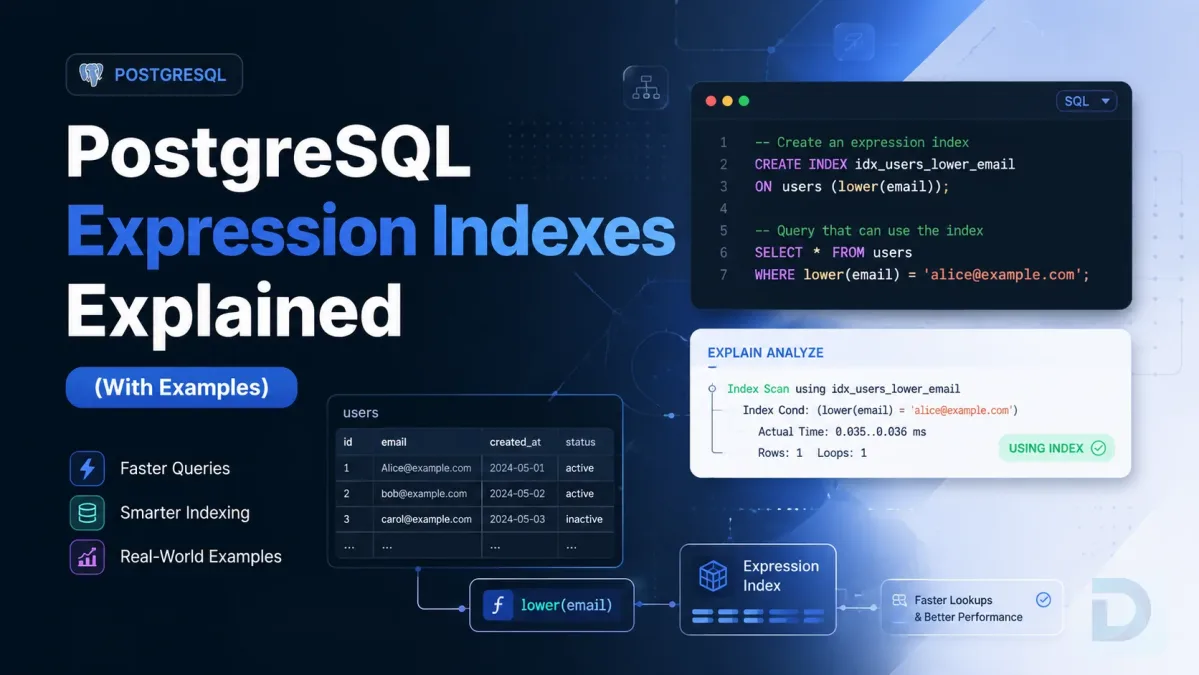
When uniqueness should ignore case, trim whitespace, or apply any immutable function, build a unique index on an expression:
CREATE UNIQUE INDEX users_email_lower_unique
  ON users (lower(email));
Now [email protected] and [email protected] collide. As a bonus, the planner uses this index for queries that filter on lower(email) as well.
Unique Constraint vs Unique Index: Key Differences
| Capability | Unique constraint | Unique index |
|---|---|---|
| Underlying structure | Unique B-tree index, created automatically | Is itself a unique B-tree index |
Partial (WHERE) support | No | Yes |
| Expression support | No | Yes |
DEFERRABLE / INITIALLY DEFERRED | Yes | No |
NULLS NOT DISTINCT (PostgreSQL 15+) | Yes | Yes |
| Built without blocking writes | Indirectly, via UNIQUE USING INDEX | Yes, with CONCURRENTLY |
Visible in pg_constraint | Yes | No (pg_indexes only) |
Usable as ON CONFLICT arbiter | Yes | Yes |
The storage and planner story is identical: same B-tree, same write overhead, same query plans. What differs is the feature set around the index and the metadata your tooling sees.
Catalog, tooling, and migration differences
- Catalogs: constraints live in
pg_constraint; standalone indexes appear only inpg_indexesandpg_class. Schema-diff tools and many ORMs reason about constraints, so a plain unique index can be invisible to them. - Naming: constraint-backed indexes inherit the constraint name (by default
table_column_key); standalone indexes use whatever you name them. - Dropping:
DROP CONSTRAINTremoves the index with it;DROP INDEXon a constraint-backed index fails outright. - Portability: a plain
UNIQUEconstraint maps cleanly across MySQL, SQL Server, and SQLite; partial and expression indexes are PostgreSQL-specific extensions.
When to Use a Unique Constraint
Treat the constraint as the default answer for enforcing data integrity.
Default choice for enforcing data integrity
Constraints are self-documenting: they state the rule in the schema itself, survive dumps and restores, appear in pg_constraint, and are understood by migration frameworks and database GUIs. If a plain-column rule fits, declare a constraint and move on.
Deferrable uniqueness checks in transactions
A deferrable unique constraint is checked at COMMIT instead of per row, which makes legitimate swap operations possible:
ALTER TABLE team_members
  ADD CONSTRAINT team_members_seat_key UNIQUE (team_id, seat)
  DEFERRABLE INITIALLY DEFERRED;
Swapping two seats with two UPDATE statements would raise duplicate key value violates unique constraint mid-transaction; deferred checking lets both statements land before validation runs. Unique indexes cannot be deferrable, so this pattern requires a constraint. One caveat: INSERT ... ON CONFLICT has limitations with deferrable arbiters, so check the INSERT documentation for your version before combining them.
Keeping migrations portable and self-documenting
ALTER TABLE ADD CONSTRAINT is the portable, reviewable option. Code reviewers, DBA runbooks, and cross-database tooling read it without translation — which matters when the same schema evolves across engines.
When to Use a Unique Index Instead

Decision flow: when to choose a unique constraint versus a unique index in PostgreSQL.
Reach for a standalone unique index when a constraint cannot express the rule, or when the build strategy matters.
Soft deletes with partial unique indexes
The partial index above is the canonical example: uniqueness applies only to rows where deleted_at IS NULL, so a soft-deleted row never blocks re-registering the same email. Upserts against a postgres partial unique index need a matching predicate:
INSERT INTO users (tenant_id, email, deleted_at)
VALUES (42, '[email protected]', NULL)
ON CONFLICT (email) WHERE deleted_at IS NULL
DO NOTHING;
For inference to find a partial index, the conflict target's WHERE must imply the index predicate — a bare ON CONFLICT (email) will not match.
Case-insensitive uniqueness with lower()
Constraints accept columns only, so any normalization — lower(), btrim(), composite expressions — requires an expression index, as shown above.
Zero-downtime builds with CONCURRENTLY
Adding a unique constraint with ALTER TABLE blocks writes while it scans the table. On a busy production system, build the index first and attach it as a constraint afterwards:
CREATE UNIQUE INDEX CONCURRENTLY users_email_key
  ON users (email);

ALTER TABLE users
  ADD CONSTRAINT users_email_key UNIQUE USING INDEX users_email_key;
CREATE INDEX CONCURRENTLY cannot run inside a transaction block, and USING INDEX accepts only a plain, non-partial, non-expression B-tree unique index — but for that common case, it turns an index into a constraint with only a brief lock.
The decision rule
Need a WHERE predicate, an expression, or a concurrent build? Use CREATE UNIQUE INDEX. Otherwise, use ADD CONSTRAINT ... UNIQUE.
Common Pitfalls and Gotchas
Dropping a constraint drops its backing index
The constraint and its index cannot be separated:
DROP INDEX users_email_key;                         -- ERROR: other objects depend on it
ALTER TABLE users DROP CONSTRAINT users_email_key;  -- drops the index too
If you need to reshape uniqueness, build the new index first, then drop the old constraint — do not leave the table without enforcement in between unless you accept the race.
Debugging duplicate key value violates unique constraint
Error 23505 reports the index or constraint name even when no constraint exists. Look the name up to see which rule fired and whether it is partial:
SELECT conname, contype
  FROM pg_constraint
 WHERE conrelid = 'users'::regclass;

SELECT indexname, indexdef
  FROM pg_indexes
 WHERE tablename = 'users';
indexdef is your friend: it reveals the WHERE clause or expression that surprises your application.
Unique constraints on partitioned tables
On partitioned tables, every unique constraint — and every unique index — must include all columns of the partition key. PostgreSQL can only enforce global uniqueness if the check routes to the right partition, so design your partitioning scheme with unique keys in mind.
FAQ
Yes. PostgreSQL creates a unique B-tree index to enforce every unique constraint, and that index appears in pg_indexes like any other index. You cannot opt out or back a constraint with an existing ordinary index.
No. ADD CONSTRAINT ... UNIQUE accepts only plain column lists. Use CREATE UNIQUE INDEX ... WHERE ... for partial uniqueness, or an exclusion constraint over GiST for more complex rules.
Neither is universally better. The constraint is the right default for plain-column integrity; the unique index wins when you need partial predicates, expressions, or concurrent builds — the three things constraints cannot do.
The SQL standard treats NULL as unknown rather than equal to anything, so two NULLs never count as duplicates. PostgreSQL 15 added NULLS NOT DISTINCT for both constraints and unique indexes, making NULL values collide like ordinary values.
Yes. The conflict target must include a WHERE predicate that implies the index predicate, for example ON CONFLICT (email) WHERE deleted_at IS NULL. Expression indexes can also be targeted by repeating the expression.
You cannot — they are one unit. DROP CONSTRAINT removes both, and DROP INDEX on the backing index fails because the constraint depends on it. If you need an equivalent index to survive, create a new standalone unique index first (concurrently if needed), then drop the constraint.
Key Takeaways
- Every PostgreSQL unique constraint is enforced by an automatically created unique B-tree index; the reverse is not true.
- Use a constraint as the default for data integrity: it is deferrable, visible in
pg_constraint, and tool-friendly. - Switch to
CREATE UNIQUE INDEXfor partial predicates, expressions, orCONCURRENTLYbuilds. NULLS NOT DISTINCT(PostgreSQL 15+) applies to both forms.DROP CONSTRAINTremoves the index;DROP INDEXon a constraint-backed index errors.ON CONFLICTworks with both, but partial arbiters require a matchingWHEREclause.
Conclusion
For plain-column uniqueness, a unique constraint and a unique index are the same object wearing different metadata — but the constraint carries more of what matters in practice: deferrable checks, catalog visibility, and portable migrations. The unique index is the deliberate escape hatch for partial rules, expressions, and zero-downtime builds. Default to the constraint; reach for the index the moment it can no longer express your rule.
If you spend your days in pg_indexes and pg_constraint, a GUI that renders both — constraints, index definitions, and their WHERE clauses — makes schema reviews far faster. Download DBO Studio to explore your PostgreSQL schemas visually; see what shipped recently in the release notes.
References: Constraints · Unique Indexes · CREATE INDEX · Partial Indexes · Expressional Indexes (PostgreSQL documentation)
About the author

Founder & Lead Developer at DBO Studio
Full-stack developer and creator of DBO Studio, a modern database management tool. Passionate about PostgreSQL, MySQL, SQLite, database performance, developer productivity, and building tools that simplify database workflows.
Try this in DBO Studio
Explore PostgreSQL workflows visually in DBO Studio — schemas, queries, and plans in one place.
Our newsletter
Subscribe to DBO Studio’s newsletter for exclusive tutorials, tips & product updatesRelated posts