Understand how MySQL handles connections, parses and optimizes SQL, delegates work to storage engines, and uses InnoDB memory and disk structures to manage data.
Introduction
Understanding mysql architecture makes many database problems easier to reason about. A slow query, high disk usage, lock contention, or memory pressure becomes less mysterious once you know which part of MySQL is responsible for each stage of the request.
MySQL is not a single component that receives SQL and directly reads files from disk. It is a layered database server. Connections are accepted and authenticated, SQL is parsed and optimized, an execution plan is run, and storage engines such as InnoDB perform the low-level work required to retrieve or modify data.
This separation is one of the most important ideas behind the MySQL server architecture. The SQL layer understands statements and decides what work should be performed, while the storage engine is responsible for much of how table data is stored, indexed, locked, and accessed.
If you understand that distinction, the rest of the MySQL internal architecture becomes much easier to follow.
MySQL Architecture at a Glance

The major layers of MySQL, from client connections through SQL processing and storage engines to persistent data.
At a high level, MySQL can be viewed as several cooperating layers:
- Client and connection layer — accepts connections, authenticates users, and manages sessions.
- SQL layer — parses statements, resolves objects, optimizes queries, and coordinates execution.
- Storage engine layer — performs table and index operations through engines such as InnoDB.
- Memory and storage structures — cache pages, maintain transactional information, and persist data to disk.
This is a simplified model, but it is useful when troubleshooting because each layer produces different types of problems.
The client-server model
Applications normally communicate with a MySQL server through a connector or client library. A backend application might use Connector/J, Connector/Python, a language-specific driver, or an ORM that ultimately sends SQL statements through a MySQL connection.
The server authenticates the connection and establishes a session. Session state includes configuration such as the current database, transaction state, character settings, and session variables.
Connection management matters because every active session consumes server resources. Applications therefore commonly use connection pools rather than repeatedly creating new connections for every query.
Main layers of the MySQL server
The SQL-processing portion of the server provides functionality shared across storage engines: parsing SQL, permissions, query optimization, execution coordination, and many administrative operations.
Below that layer is MySQL's pluggable storage engine interface. MySQL's documentation describes this architecture as a way for the server to expose a consistent interface while storage engines implement the physical data operations underneath it. ([MySQL][1])
Server layer vs storage engine layer
This boundary is essential.
Consider:
sql SELECT id, email FROM users WHERE email = '[email protected]';
The MySQL server parses the statement and determines how it might be executed. If users is an InnoDB table, the executor eventually asks InnoDB to perform the required table or index access.
The optimizer does not directly open an InnoDB data file and search bytes itself. It works through the storage-engine interface.
That separation is what makes the MySQL storage engine architecture modular.
Connection and SQL Processing Layer
The SQL layer is where incoming statements are transformed from text into executable database operations.
Client connections and thread management
When a client connects, MySQL authenticates it and establishes a server session. In the traditional execution model, connection activity is associated with server threads, although exact thread scheduling can differ depending on configuration and available thread-pool functionality.
This layer also enforces account privileges and maintains connection-specific state.
From an operational perspective, an application opening too many concurrent connections can create pressure even when individual queries are fast. Connection count, query concurrency, and query efficiency therefore need to be considered together.
Parsing and validating SQL statements
When MySQL receives SQL, it first needs to understand its structure.
For a query such as:
sql SELECT name FROM customers WHERE id = 42;
MySQL processes the statement, resolves referenced objects and columns, checks relevant permissions, and prepares it for optimization and execution.
A syntax error or reference to a nonexistent object fails before normal data retrieval can occur. This is one reason it is useful to think of parsing and execution as separate stages.
How the query optimizer chooses an execution plan
For SELECT statements and other operations requiring access-path decisions, the query optimizer evaluates possible strategies for obtaining the requested data.
It can consider questions such as:
- Which table should be accessed first in a join?
- Can an index be used?
- Which available index is likely to be cheapest?
- Is scanning rows more efficient than using a particular index?
- Which join strategy and access path should be selected?
These decisions depend on the query, available indexes, optimizer statistics, predicates, and data distribution.
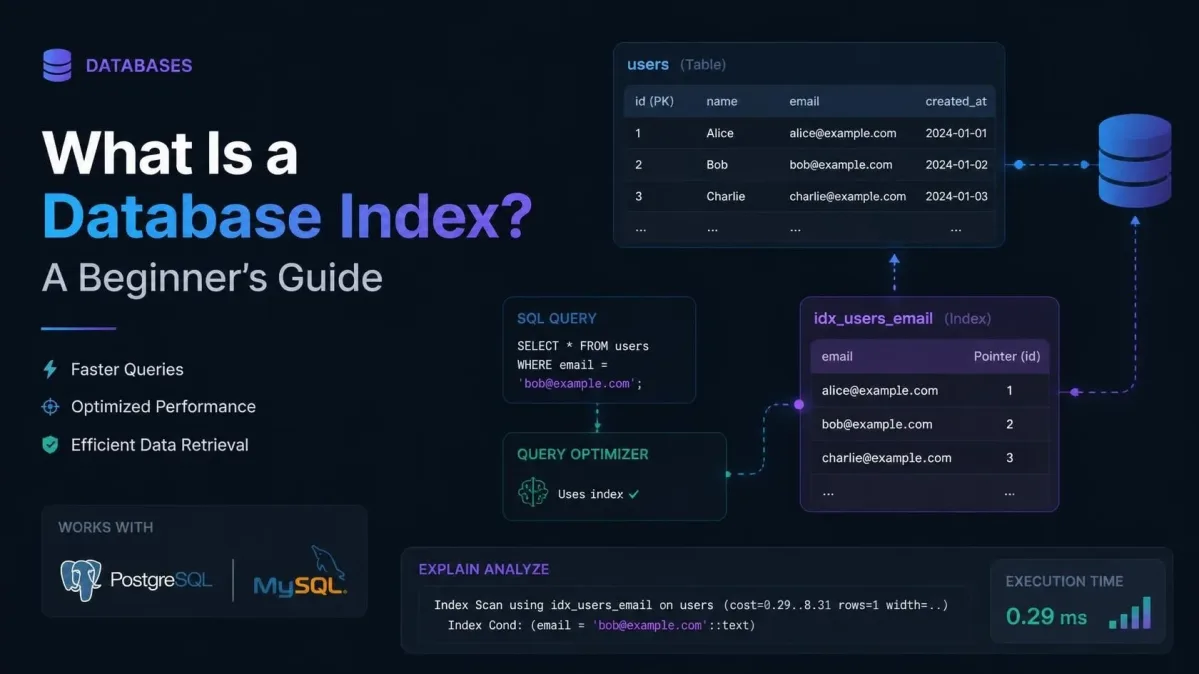
If you want a foundation for understanding why indexes affect those decisions, see What Is a Database Index?.
Importantly, an execution plan is an estimate-based decision. The optimizer is trying to choose an efficient strategy before the query actually performs all of its work.
Executing the optimized query
Once a plan is selected, the execution layer performs the operations represented by that plan. When rows need to be retrieved from an InnoDB table, requests cross the storage-engine boundary.
At that point, things such as B-tree traversal, row visibility, locking, buffer-pool access, and physical I/O become primarily InnoDB concerns.
This distinction helps explain why a query can be logically simple at the SQL level but still be expensive at the storage level.
MySQL Storage Engine Architecture
A defining feature of MySQL database architecture is its support for multiple storage engines. The storage engine is responsible for performing operations against the underlying table data rather than implementing the entire SQL server itself.
How pluggable storage engines work
The server communicates with storage engines through a defined internal interface. This allows higher-level SQL functionality to remain relatively independent of the engine storing a particular table.
MySQL documents storage engines as the components that perform actions on data maintained at the physical server level. ([MySQL][1])
Different engines can therefore offer different capabilities while applications continue using SQL through the common server layer.
Responsibilities of the common server layer
The common server layer handles functionality that should not need to be independently reimplemented by every storage engine. Conceptually, this includes areas such as:
- client connectivity and authentication
- SQL parsing
- privilege checks
- query optimization
- execution coordination
- storage-engine integration
The storage engine then provides its engine-specific implementation of table access, indexes, persistence, locking, and transactional behavior where applicable.
Why InnoDB is the primary storage engine
For normal transactional MySQL workloads, InnoDB is the storage engine developers encounter most often. It supports ACID-oriented transaction processing, row-level locking, crash recovery, foreign keys, and multi-version concurrency control.
The MySQL 8.4 documentation dedicates separate sections to InnoDB's memory structures, on-disk structures, locking, transactions, redo logs, undo logs, tablespaces, and disk I/O. ([MySQL][2])
Because InnoDB is central to modern MySQL deployments, understanding MySQL architecture usually requires understanding InnoDB architecture as well.
Where other storage engines fit
MySQL also provides other engines for specialized requirements. For example, MyISAM and MEMORY have substantially different storage and transaction characteristics from InnoDB.
The important architectural lesson is not to memorize every engine. It is to recognize that SQL processing and physical storage are separated by the storage-engine abstraction.
Inside the InnoDB Architecture
The MySQL InnoDB architecture combines memory structures, persistent data structures, transaction metadata, logs, and background processing.
Buffer pool and in-memory structures
The InnoDB buffer pool is one of the most important components for performance. It caches table and index pages in memory so frequently accessed data does not require physical disk reads every time it is requested.
When InnoDB needs a page, it first benefits if that page is already available in the buffer pool. If not, the page may have to be fetched from storage, introducing disk I/O.
Modified pages can remain in memory as dirty pages before background processing eventually writes them to their persistent tablespaces.
This means database memory is not simply a query-result cache. InnoDB is caching database pages that participate directly in storage operations.
Tablespaces and data pages
InnoDB organizes persistent data using tablespaces. Tables and indexes are represented internally as pages arranged in structures such as B-trees.
MySQL supports several types of InnoDB tablespaces, including system, file-per-table, general, undo, and temporary tablespaces. ([MySQL][2])
This page-oriented model explains why database performance discussions frequently involve page reads, page writes, buffer-pool hit behavior, and random versus sequential I/O rather than simply talking about individual rows on disk.
Redo logs and crash recovery
The redo log records information needed to reproduce changes during crash recovery. InnoDB follows write-ahead logging principles: relevant redo information is persisted as required before modified data pages need to reach their final locations on disk.
This allows data pages to be flushed independently rather than requiring every changed page to be synchronously written to its tablespace at each transaction commit.
The redo log should not be confused with the MySQL binary log. Redo is an InnoDB mechanism closely tied to crash recovery and physical changes. The binary log belongs to the MySQL server layer and records events used for functions such as replication and point-in-time recovery workflows.
Undo logs and transaction visibility
Undo logs preserve information required to reverse changes and help InnoDB provide consistent reads through multi-version concurrency control.
Suppose one transaction updates a row while another transaction needs to read a version that is valid for its transaction view. InnoDB's versioning mechanisms can use undo information to reconstruct an earlier version when necessary.
This is a major reason MySQL transactions involve more than simply changing the current row value in a data page.
Background I/O and internal processing
InnoDB also performs substantial work outside the foreground query path. Background activity includes flushing dirty pages, processing I/O, checkpoint-related work, and cleaning up obsolete row versions.
As a result, storage performance can affect MySQL even after an application query appears to have completed. A write-heavy workload may create dirty pages and redo activity that must later be processed by background components.
How a Query Moves Through MySQL

A simplified query lifecycle from the client request to SQL processing, InnoDB data access, and the returned result.
A practical way to understand how MySQL works is to follow one request through the architecture.
Step 1: A client sends a SQL statement
An application obtains a database connection and sends SQL to the MySQL server. The server associates the request with the appropriate authenticated session.
Step 2: MySQL parses and optimizes the query
The SQL layer validates the statement and builds the internal representation required for execution. For queries requiring optimization, the optimizer evaluates possible access paths and chooses an execution plan.
Step 3: The execution layer calls the storage engine
When the plan requires table access, the executor communicates with the relevant storage engine.
For an InnoDB table, this means the request now enters InnoDB's data-access and transaction machinery.
Step 4: InnoDB reads or modifies data
InnoDB checks its memory structures, including the buffer pool. Required pages already in memory can be accessed without first reading them from disk. Missing pages may require storage I/O.
For writes, InnoDB also coordinates transaction state, locking, undo information, redo generation, and dirty pages as required by the operation.
Step 5: MySQL returns the result to the client
Rows produced by execution move back through the server and are returned using the client protocol.
The full conceptual path is therefore:
Client -> Connection -> Parser -> Optimizer -> Executor -> Storage Engine -> Buffer Pool / Storage -> Result
That model is intentionally simplified, but it is extremely useful when diagnosing real systems.
Examples
Consider this query:
sql SELECT id, total FROM orders WHERE customer_id = 1001;
If an appropriate index exists, the optimizer may choose an indexed access path. The execution layer asks InnoDB to find the matching records. InnoDB traverses the required index pages, using pages already available in the buffer pool when possible and performing disk reads when necessary.
You can inspect the optimizer's chosen strategy with:
sql EXPLAIN SELECT id, total FROM orders WHERE customer_id = 1001;
The exact plan depends on the schema, indexes, statistics, and data distribution, so an example plan should never be treated as universal.
A write illustrates additional components:
sql UPDATE accounts SET balance = balance - 100 WHERE id = 42;
The SQL layer still parses and coordinates the statement, but InnoDB must additionally handle transactional concerns such as locating and locking the target record, maintaining undo information, modifying pages in memory, and generating redo information required for durability and recovery.
That is why understanding the architecture is much more useful than thinking of MySQL as simply a program that reads and writes table files.
Why MySQL Architecture Matters for Performance
Architecture gives you a framework for deciding where to investigate a performance problem.
If CPU usage is high, expensive SQL execution or excessive concurrency may be involved. If storage latency is high and the workload performs many physical reads, buffer-pool behavior or access patterns may deserve attention. If transactions block one another, investigate locks and transaction design rather than immediately increasing server memory.
The same reasoning helps separate query optimization problems from storage problems. A poor execution plan can cause MySQL to request far more rows or pages than necessary. In that case, faster disks may reduce the symptom without addressing the inefficient plan.
Conversely, a sensible query plan can still perform poorly if the server is under severe I/O pressure or its working set cannot be served efficiently from memory.
Useful questions include:
- Is the query spending time in SQL execution or waiting on storage?
- Is the expected access path actually being chosen?
- Are frequently accessed pages staying in the buffer pool?
- Is the workload generating excessive reads or writes?
- Are transactions waiting on locks?
- Is connection concurrency overwhelming available resources?
Tools that let you inspect schemas, run SQL, and analyze database objects can make this investigation easier. You can download DBO Studio if you want a desktop database environment for working with MySQL alongside other database systems.
Key Takeaways
- MySQL is a layered client-server database system, not a single SQL-to-disk component.
- The server layer handles connections, SQL parsing, optimization, and execution coordination.
- Storage engines implement lower-level table and index operations behind a common interface.
- InnoDB is the central storage engine for typical transactional MySQL workloads.
- The buffer pool keeps frequently used data and index pages in memory and strongly affects I/O behavior.
- Tablespaces hold persistent InnoDB structures, while redo and undo serve different transactional purposes.
- InnoDB redo logs and MySQL binary logs solve different problems and should not be treated as interchangeable.
- Following the query path from client to storage is an effective way to diagnose performance bottlenecks.
Conclusion
The most useful mental model for MySQL architecture is a pipeline with clear responsibility boundaries: clients connect to the server, the SQL layer interprets and optimizes requests, the executor works through a storage engine, and InnoDB manages transactional data using memory structures, logs, tablespaces, and persistent storage.
You do not need to memorize every internal subsystem to benefit from this model. What matters is knowing which layer owns which responsibility. Once that is clear, concepts such as query plans, indexes, buffer-pool pressure, redo activity, transaction locks, and disk I/O fit into a coherent system rather than appearing as unrelated MySQL features.
For deeper implementation details, the official MySQL documentation covers the pluggable storage engine architecture, InnoDB storage engine, introduction to InnoDB, and InnoDB disk I/O and file-space management.
FAQ
The main conceptual components are the client and connection layer, SQL-processing layer, execution layer, pluggable storage engines, and the memory and persistent-storage structures used by engines such as InnoDB.
The server layer handles common functionality such as connections, SQL parsing, permissions, query optimization, and execution coordination. Storage engines handle lower-level table and index operations and provide engine-specific storage and transaction behavior.
A client sends SQL through a connection. MySQL parses and validates the statement, the optimizer selects an execution strategy where applicable, the executor requests data from the storage engine, and the resulting rows are returned to the client.
InnoDB is the storage engine responsible for storing and retrieving data for InnoDB tables while providing transactional features such as locking, MVCC, crash recovery, redo logging, undo information, and buffer-pool management.
For InnoDB, persistent table and index data is organized in tablespaces. InnoDB also maintains redo and undo structures for transaction processing and recovery. The MySQL server separately maintains the binary log when binary logging is enabled; its purpose differs from the InnoDB redo log.
About the author

Founder & Lead Developer at DBO Studio
Full-stack developer and creator of DBO Studio, a modern database management tool. Passionate about PostgreSQL, MySQL, SQLite, database performance, developer productivity, and building tools that simplify database workflows.
Try this in DBO Studio
Explore MySQL workflows visually in DBO Studio — schemas, queries, and plans in one place.
Our newsletter
Subscribe to DBO Studio’s newsletter for exclusive tutorials, tips & product updatesRelated posts